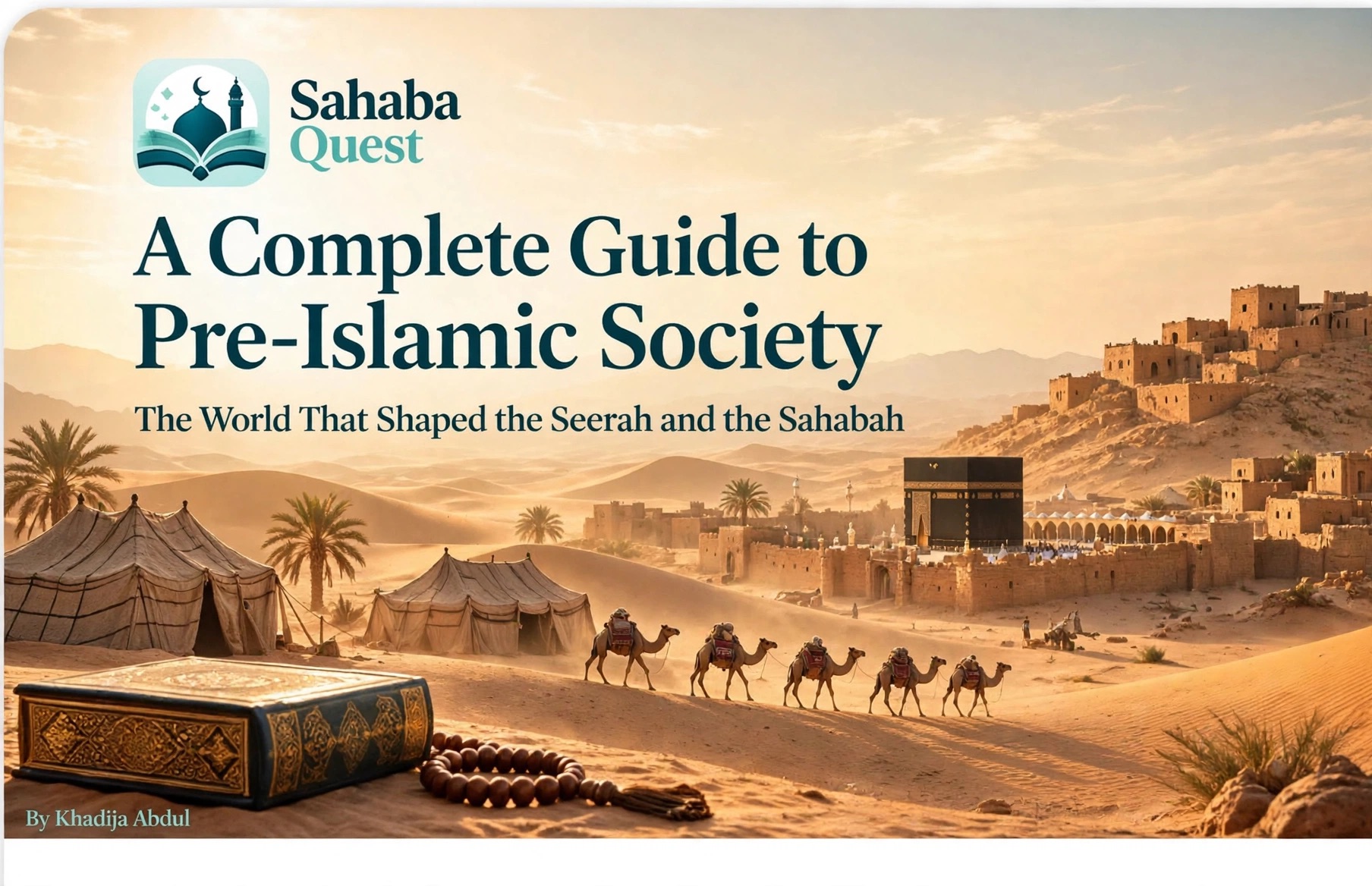
A COMPLETE GUIDE TO PRE-ISLAMIC SOCIETY: THE WORLD THAT SHAPED THE SEERAH AND THE SAHABA
Introduction: Why We Must Start Before The Seerah
Most people start the Seerah from the birth of the Prophet ﷺ. But you cannot understand the light until you understand the darkness it came to remove.
Allah called that time Jahiliyyah, not because the Arabs were stupid. They were poets, traders, brave warriors, generous hosts. They had a beautiful language and a sharp memory. But they were ignorant of Tawheed, of the purpose of life, and of true justice.
Allah says:
* وَمَا كُنَّا مُعَذِّبِينَ حَتَّىٰ نَبْعَثَ رَسُولًا "We would not punish until We sent a Messenger." [Qur'an 17:15]*
Pre-Islamic Arabia was not one country. It was deserts, mountains, oases and tribes. Makkah was dry and rocky but rich because of trade and the Ka'bah. Yathrib was green and fertile. Yemen was rich with dams and agriculture. Najd was harsh. The Arabs were divided, but they shared one thing: pride in tribe, in lineage, in poetry, and in freedom.
When Islam came, it did not just give them new prayers. It gave them a new heart, a new family, and a new world.
Social Injustice in Pre-Islamic Arabia: Understanding the Context of Reform
The pre Islamic society was a world where there was no law except the sword. The strong tribe ate the weak one. If a rich man from Quraysh killed a man from a weak tribe, no blood-money was paid. If a weak man killed a strong man, a whole war would start.
There was no court for the oppressed foreign merchant. If you came to Makkah for trade and a Qurayshi cheated you, you had no one to complain to, unless you had a powerful protector.
Wars started for pride. The War of Basus lasted 40 years because a camel was killed. The War of Dahis and Ghabra lasted 40 years because of a horse race. The War of Fijar started in the sacred months because of an insult in the market of Ukaz. Life was cheap, honour was expensive.
That is why the Prophet ﷺ loved Hilf Al-Fudul before Prophethood. A Yemeni merchant came to Makkah and Al-As ibn Wa'il refused to pay him. The man climbed Abu Qubays mountain and cried for help. The nobles gathered in the house of Abdullah ibn Jud'an and swore: "We will stand with the oppressed until his right is returned." The Prophet ﷺ said after Islam: "I witnessed a pact in the house of Abdullah ibn Jud'an that I would not exchange for red camels. If I am called to it in Islam, I will answer."
Islam came to establish justice, not tribal victory.
إِنَّ اللَّهَ يَأْمُرُ بِالْعَدْلِ وَالْإِحْسَانِ *"Indeed, Allah orders justice and good conduct." [Qur'an 16:90]*
* *اتَّقُوا الظُّلْمَ، فَإِنَّ الظُّلْمَ ظُلُمَاتٌ يَوْمَ الْقِيَامَةِ
*"Beware of oppression, for oppression will be darkness on the Day of Resurrection." [Sahih Muslim 2578]*
Example - Suhayb Ar-Rumi (RA): Suhayb was an Arab that spent most of his life as a foreigner in Rum, He was rich in Makkah, but when he wanted to migrate to Madinah, Quraysh stopped him and said, "You came poor, now you want to leave rich?" He gave them all his wealth and said, "Take my wealth and let me go to Muhammad." He arrived with nothing. The Prophet ﷺ smiled and said: "Suhayb has profited! Suhayb has profited!" In Jahiliyyah, a foreigner had no right. In Islam, a foreigner became a hero.
Women, Family, Slavery, and Social Status
In Jahiliyyah, a woman was not a person, she was property. A man inherited his father's wives after his death. There was no limit to marriage. A man could marry ten, twenty wives, and divorce them when he wanted. A woman had no inheritance, no mahr of her own, no voice.
Daughters were a source of shame because they could not fight, could not protect the tribe, and could cost the family honour if captured in war. Some tribes, like Banu Tamim, buried their daughters alive out of poverty or fear of shame.
The Qur'an records their crime in a question that will shake the heavens:
* *وَإِذَا الْمَوْءُودَةُ سُئِلَتْ، بِأَيِّ ذَنبٍ قُتِلَتْ *"When the girl buried alive is asked, for what sin she was killed." [Qur'an 81:8-9]*
Slavery was normal. Slaves were bought in the markets of Makkah, Yemen and Shaam like animals. A master could beat, starve, or kill his slave. A black slave had even less value.
But look at the Sahaba's transformation. This is why the Seerah is powerful.
Umar ibn Al-Khattab (RA): Umar himself admitted he buried his daughter alive in Jahiliyyah. He said he dug the hole while she wiped dust from his beard, not knowing she was about to be killed. After Islam, this same Umar became so soft that he would cry hearing a child cry in the night. He would walk the streets of Madinah at night to check if any child was hungry. He established stipends for every newborn in Madinah, even before weaning, because he heard a mother trying to wean her baby early to get the allowance. Jahiliyyah made him hard. Islam made him merciful.
Bilal ibn Rabah (RA): Bilal was a black Abyssinian slave. His master Umayyah ibn Khalaf would drag him on the hot sand of Makkah at noon, placing a huge boulder on his chest, saying "Deny Muhammad, worship Lat and Uzza." Bilal only said "Ahadun Ahad - One, One." Abu Bakr (RA) bought him and freed him for the sake of Allah. The Prophet ﷺ then made him the first Mu'azzin - the voice of Islam, from slave to the highest minaret. On the Day of the Conquest of Makkah, Bilal stood on top of the Ka'bah and gave the Adhan. The same Ka'bah where idols were worshipped, now echoed with Tawheed from a freed black slave.
Sumayyah bint Khayyat (RA): Sumayyah was the first martyr in Islam. She was a slave woman, old and weak, from the family of Yasir. Abu Jahl tortured her, her husband Yasir, and her son Ammar in the heat of Makkah. He demanded she insult the Prophet ﷺ. She refused. Abu Jahl speared her and killed her. In Jahiliyyah, a slave woman was nothing. In Islam, she became the first martyr, and the Prophet ﷺ said her family would have Paradise.
Khadijah (RA):In a society that buried girls, Khadijah became the most successful business woman of Makkah. She hired men, traded to Shaam, and was called At-Tahirah, the Pure One, even before Islam. She was the first to believe, the first to pray, and she spent her wealth to support the Dawah. Islam did not humiliate women. It honoured them.
إِنَّ أَكْرَمَكُمْ عِندَ اللَّهِ أَتْقَاكُمْ *"The most noble of you in the sight of Allah is the most righteous." [Qur'an 49:13]*
The Jewish and Christian Communities of Arabia
Arabia was not only pagan. It was a crossroads of religions.
Makkah was pagan, but Yathrib was Jewish. Three major Jewish tribes lived there: Banu Qaynuqa were goldsmiths and craftsmen in the market. Banu Nadir and Banu Qurayzah were landowners, they owned the best date farms, controlled the date markets and weapons. They had the Torah, they knew of Prophets, and they expected a Prophet to come, but they expected him from their lineage, from Bani Israel, not from Bani Ismail.
Najran in Yemen was Christian. Shaam was under Christian Romans. Abyssinia was Christian. There were also Hanifs - people like Waraqah ibn Nawfal, Zayd ibn Amr ibn Nufayl, who rejected idols and searched for the religion of Ibrahim (AS).
This is why”Waraqah ibn Nawfa”, Khadijah's (RA) cousin, was so important. He was a Christian Hanif who could read Hebrew and the Gospel. When Khadijah (RA) took the Prophet ﷺ to him after the first revelation in Hira, Waraqah immediately said: "This is the Namus that came to Musa. If only I were young when your people will drive you out." The Prophet ﷺ was shocked: "Will they drive me out?" Waraqah said: "No Prophet came with what you came with except he was opposed."
The Jews in Yathrib also prepared the ground without knowing. When they fought the Arabs of Aws and Khazraj, they would threaten: "A Prophet is about to come, we will kill you with him as Ad and Iram were killed." So the Arabs of Yathrib were waiting for a Prophet.
Allah used all these communities to prepare Arabia for Islam.
Why Understanding Pre-Islamic Arabia Helps Us Understand the Sahaba.
If you don't know Jahiliyyah, you will never understand the Sahabah. Their sacrifices will look small. But when you know what they left, you will know how big their Iman was. Example are:
Mus'ab ibn Umayr (RA): Mas’ab was the most stylish youth of Makkah. He wore the best clothes from Yemen, the best perfumes, his hair was combed, his shoes were the most expensive. His mother Khunnas was very rich and loved him deeply. When he accepted Islam, his mother locked him in a room, chained him, and starved him. He escaped. He left everything and became so poor his skin cracked, his clothes became patched with leather. He became the first ambassador of Islam to Yathrib. He taught Qur'an house by house. He left luxury for Dawah. He died at Uhud with only a small cloth to cover him - if they covered his head, his feet showed, if they covered his feet, his head showed.
Abu Bakr As-Siddiq (RA): In Jahiliyyah he was a rich merchant, expert in lineage, respected by all Quraysh. In Islam, he spent his entire wealth - 40,000 dirhams - freeing slaves like Bilal, Ammar, and others, and supporting the Prophet ﷺ. When he migrated, he took only 5,000 dirhams with him. He gave everything for Allah.
Hamzah ibn Abdul Muttalib (RA): Hamzah was the Lion of Quraysh, the best hunter, the bravest warrior, feared by all. When Abu Jahl insulted the Prophet ﷺ, Hamzah came with his bow and struck Abu Jahl on his head until blood flowed. He announced his Islam openly. In Jahiliyyah, his bravery was for tribal pride. In Islam, his bravery became for Allah. He died at Uhud as Sayyidush-Shuhada, the Leader of Martyrs.
Salman Al-Farisi (RA): Salman was a Persian from a rich fire-worshipping family. He left his home searching for truth. He was sold as a slave, from master to master, until he reached Madinah. He worked in the date farms as a slave until the Prophet ﷺ helped free him. In Jahiliyyah, a Persian slave was nothing. In Islam, Salman became the one who suggested digging the Trench at Khandaq, and the Prophet ﷺ said: "Salman is from us, Ahlul Bayt."
* *
هُوَ الَّذِي بَعَثَ فِي الْأُمِّيِّينَ رَسُولًا مِّنْهُمْ يَتْلُو عَلَيْهِمْ آيَاتِهِ وَيُزَكِّيهِمْ
*"It is He who sent among the unlettered a Messenger... purifying them." [Qur'an 62:2]*
Yathrib Before the Hijrah: The Communities That Shaped Madinah
Yathrib was the opposite of Makkah. Makkah was dry, rocky, no farming. Yathrib was fertile, full of date palms, springs and water. It was called Yathrib because of its sickness and fevers, but after Hijrah it became Madinatun-Nabi, the City of the Prophet, and Al-Madinah Al-Munawwarah, the Illuminated City.
Its Arabs were Aws and Khazraj, two brothers from Yemen who migrated after the breaking of the Dam of Ma'rib. They became enemies. The Jews played them against each other. The bloody Battle of Bu'ath killed their leaders five years before Hijrah, leaving them exhausted, without leaders, and looking for a peacemaker.
There were also Jewish tribes, and small Christian groups, and idol worshippers. Yathrib was divided, tired of war, and ready for a leader who would unite them.
The Jews used to say when they fought: "A Prophet is about to come, we will kill you with him as Ad and Iram were killed." When the Aws and Khazraj heard of the Prophet ﷺ in Aqabah, they said: "By Allah, this is the Prophet the Jews threaten us with, let us beat them to him."
Allah prepared Yathrib. The first pledge of Aqabah was 12 men. The second was 73 men and women. They invited the Prophet ﷺ to their city, and they promised to protect him as they protect their own wives and children.
* *وَالَّذِينَ تَبَوَّءُوا الدَّارَ وَالْإِيمَانَ مِن قَبْلِهِمْ يُحِبُّونَ مَنْ هَاجَرَ إِلَيْهِمْ *"Those who were settled in Madinah... they love those who emigrated to them." [Qur'an 59:9]*
Sa'd ibn Mu'adh (RA): Sa'd was the leader of Aws. When Mus'ab came to Yathrib, Sa'd was angry. But after hearing Qur'an, he believed in one sitting. He went to his people and said: "Your words are haram upon me until you believe in Allah and His Messenger." By evening, the whole tribe of Banu Abdul Ashhal had become Muslim. One man's Iman changed a whole city.
How Tribal Alliances and Protection Influenced Life.
If you had no tribe, you were dead. You could not travel, you could not trade, you could not get justice. Protection was of two types: Hilf (alliance between tribes) and Jiwar (protection by a chief or a powerful man).
A weak man would go to a strong chief and say, "I am your neighbour, protect me." The chief would announce it, and from that moment, attacking that man was attacking the chief's tribe. That was Jiwar.
Protection of the Prophet ﷺ: When Abu Talib died, the Prophet ﷺ lost his protection. The Quraysh increased their torture. He went to Ta'if to seek support, and was stoned until his shoes filled with blood. He could not enter Makkah until Mut'im ibn Adi, a mushrik, gave him Jiwar. Mut'im sent his sons with swords and announced in the Haram: "Muhammad is under my protection." This is how serious protection was. Even the Prophet ﷺ needed Jiwar in Jahiliyyah system.
Uthman ibn Maz'un (RA): Uthman was being tortured in Makkah. He entered the Jiwar of Al-Walid ibn Al-Mughirah. When he saw Muslims being tortured while he was safe in the Ka'bah, he could not bear it. He returned the Jiwar in public, saying "I want the protection of Allah, not a man. I am content with Allah's protection." He was beaten until his eye swelled, but he said: "My healthy eye also wishes for what its sister got for Allah."
The Ansar and the Muhajirun: In Islam, Allah replaced tribal alliance with brotherhood of Iman. The Prophet ﷺ paired one Muhajir with one Ansari as brothers. Sa'd ibn Ar-Rabi (RA), an Ansari, said to Abdur Rahman ibn Awf (RA), a Muhajir: "I have two gardens, take one. I have two wives, choose one and I will divorce her for you." Abdur Rahman said: "May Allah bless your family and wealth. Show me the market." That is not tribal alliance. That is Iman.
Islam kept noble alliance and removed blind fanaticism.
انْصُرْ أَخَاكَ ظَالِمًا أَوْ مَظْلُومًا... تَأْخُذُ فَوْقَ يَدَيْهِ *"Help your brother whether oppressor or oppressed... by stopping him." [Sahih al-Bukhari 2444]*
In Jahiliyyah, that hadith meant: "Help your brother even if he is wrong, because he is your tribe." In Islam, the Prophet ﷺ redefined it: "Help the oppressor by stopping his hand from oppression, and help the oppressed by giving him his right."
Final Word: From Darkness to Mercy
So Allah sent Muhammad ﷺ not just to teach prayer, but to free Bilal, to honour women through Khadijah (RA) the businesswoman, to turn tribal enemies Aws and Khazraj into Ansar who shared their homes, to turn a slave like Salman into family of the Prophet ﷺ, and to make justice real for the foreign merchant, the orphan, and the widow.
Jahiliyyah said: "Your value is your tribe, your colour, your wealth."
Islam said: "Your value is your Taqwa."
وَمَا أَرْسَلْنَاكَ إِلَّا رَحْمَةً لِّلْعَالَمِينَ
"We have not sent you except as a mercy to the worlds." [Qur'an 21:107]
If you understand Pre-Islamic Arabia, you will understand why the Sahaba loved the Prophet ﷺ so much. They knew what darkness they came from, and what light Allah gave them.