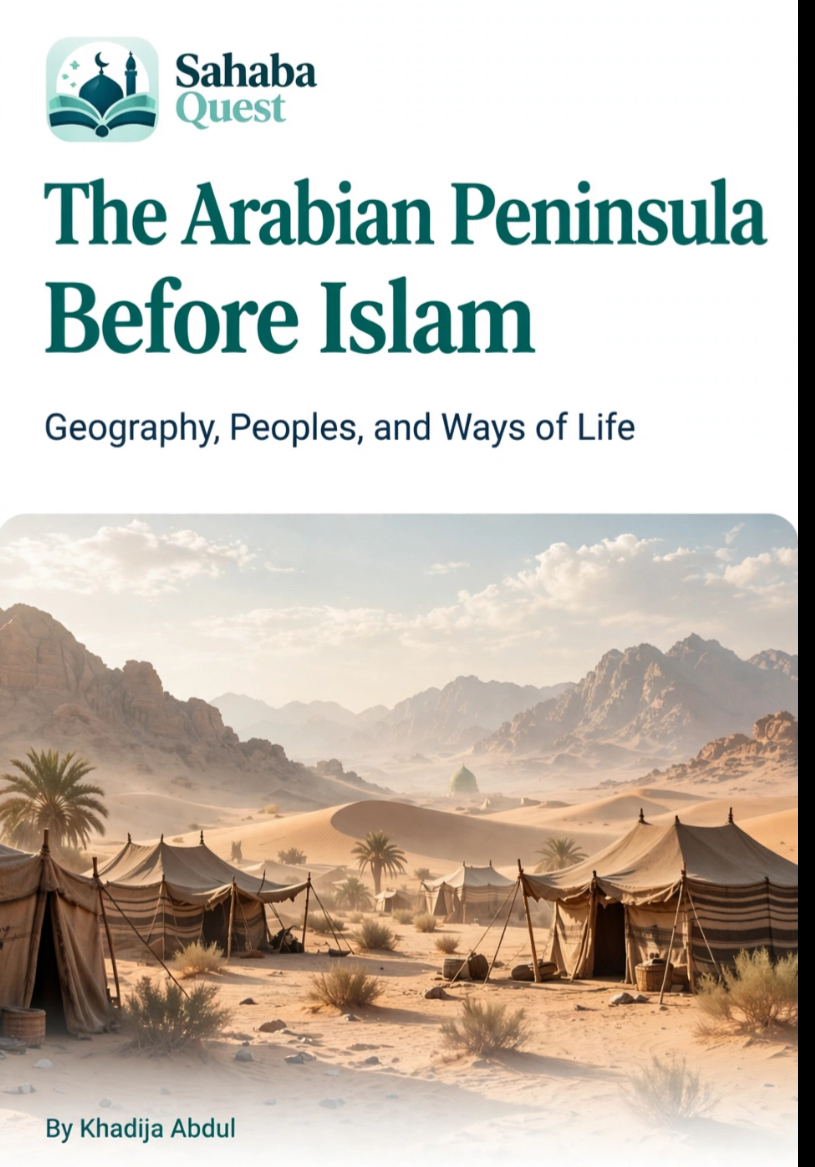
THE ARABIAN PENINSULA BEFORE ISLAM: Geography, Peoples, and Ways of Life
Introduction
To understand Islam, we must understand where it began. Allah chose the Arabian Peninsula to send His last Messenger ﷺ.
Geography
Arabia is mostly desert, with harsh heat, little water, and mountains. The Arabs called the heart of it _Jazirat al-Arab - the Island of the Arabs. It had three main regions: Hijaz (where Makkah and Madinah are), Najd in the center, and Yemen in the south which was greener and known for agriculture.
Despite the harsh land, Arabs were resilient, known for patience, eloquence in language, generosity to guests, and strong memory.
Peoples and Ways of Life
Arabs were of two types:
- Ahl al-Badiyah (Bedouins): Nomads who moved with camels and sheep seeking water and pasture.
- Ahl al-Hadar (Town dwellers): Who lived in cities like Makkah, Yathrib (Madinah), and Ta'if, engaging in trade and agriculture.
Allah reminds us that He created us as peoples and tribes so we may know one another:
يَا أَيُّهَا النَّاسُ إِنَّا خَلَقْنَاكُم مِّن ذَكَرٍ وَأُنثَىٰ وَجَعَلْنَاكُمْ شُعُوبًا وَقَبَائِلَ لِتَعَارَفُوا
*"O mankind, indeed We have created you from male and female and made you peoples and tribes that you may know one another." [Qur'an 49:13]*
The Prophet ﷺ praised the good character that already existed among Arabs:
* *
إِنَّمَا بُعِثْتُ لِأُتَمِّمَ مَكَارِمَ الْأَخْلَاقِو
*"I was only sent to perfect good character." [Muwatta Imam Malik]*
MAKKAH BEFORE ISLAM: The Ka'bah, Pilgrimage, and the Quraysh
Makkah is Umm al-Qura, the Mother of Cities. Allah made it sacred from the day He created the heavens and earth.
The Ka'bah and Pilgrimage
The Ka'bah was built by Ibrahim and Isma'il (AS). Even before Islam, Arabs knew it was sacred and performed Hajj, but they had corrupted it with shirk.
They would circumambulate naked, clap and whistle, and ask idols for needs.
Allah says:
* *
وَمَا كَانَ صَلَاتُهُمْ عِندَ الْبَيْتِ إِلَّا مُكَاءً وَتَصْدِيَةً
*"And their prayer at the House was not except whistling and handclapping." [Qur'an 8:35]*
The Quraysh
Quraysh were the tribe of the Prophet ﷺ, custodians of the Ka'bah. They were honored among all Arabs for this. They controlled Siqayah (providing water to pilgrims) and Rifadah (feeding them).
Allah honored them with security and trade:
لِإِيلَافِ قُرَيْشٍ، إِيلَافِهِمْ رِحْلَةَ الشِّتَاءِ وَالصَّيْفِ "For the accustomed security of the Quraysh - Their accustomed security [in] the caravan of winter and summer." [Qur'an 106:1-2] > The Prophet ﷺ said about Makkah:
وَاللَّهِ إِنَّكِ لَخَيْرُ أَرْضِ اللَّهِ، وَأَحَبُّ أَرْضِ اللَّهِ إِلَى اللَّهِ
* "By Allah, you are the best land of Allah, and the most beloved land to Allah." [Sunan al-Tirmidhi 3925]*
TRIBAL SOCIETY IN PRE-ISLAMIC ARABIA: Family, Honour, Loyalty, and Protection
Arab society was built on the tribe. Your tribe was your army, your government, and your identity.
Family and Honour
Lineage (Nasab) was everything. They memorized genealogies for generations. Honour (Sharaf) was defended with blood. A man would fight to death to protect his tribe's honour and his women.
Loyalty and Protection (Asabiyyah)
The famous saying of Jahiliyyah was: "Help your brother whether he is an oppressor or oppressed." Meaning blind loyalty.
Islam corrected this. The Prophet ﷺ said:
انْصُرْ أَخَاكَ ظَالِمًا أَوْ مَظْلُومًا، قَالُوا: يَا رَسُولَ اللَّهِ، هَذَا نَنْصُرُهُ مَظْلُومًا، فَكَيْفَ نَنْصُرُهُ ظَالِمًا؟ قَالَ: تَأْخُذُ فَوْقَ يَدَيْهِ
*"Help your brother whether he is an oppressor or an oppressed." They said: "O Messenger of Allah, we help the oppressed, but how do we help an oppressor?" He said: "By stopping him from oppressing." [Sahih al-Bukhari 2444]*
There was also protection (Jiwar). If a weak person entered the protection of a strong chief, no one could harm him.
Islam came to keep the good of tribal ties (silat al-rahim) and remove blind fanaticism.
وَأُولُو الْأَرْحَامِ بَعْضُهُمْ أَوْلَىٰ بِبَعْضٍ *"But those of [blood] relationship are more entitled [to inheritance] in the decree of Allah." [Qur'an 8:75]*
TRADE AND TRAVEL IN ARABIA: How Makkah Connected Different Peoples
Makkah had no crops, but Allah gave Quraysh wealth through trade. Its location in the middle of the world trade route made it rich.
Trade Routes
Quraysh led two great journeys:
Rihlat al-Shita (Winter journey to Yemen - warm lands, spices, perfumes)
Rihlat al-Saif (Summer journey to Shaam (Syria) - grains, textiles, weapons)
Through this, Makkah became a meeting point of Romans, Persians, Yemenis, and Abyssinians.
Allah reminds them of this favor:
أَوَلَمْ نُمَكِّن لَّهُمْ حَرَمًا آمِنًا يُجْبَىٰ إِلَيْهِ ثَمَرَاتُ كُلِّ شَيْءٍ رِّزْقًا مِّن لَّدُنَّا
*"Have We not established for them a safe sanctuary to which are brought the fruits of all things as provision from Us?" [Qur'an 28:57]*
Travel
Travel was dangerous. Caravans needed guides who knew the stars. The Arabs were experts in stars (Anwa') for navigation.
The Prophet ﷺ himself traveled for trade with Khadijah (RA). He was known as As-Sadiq Al-Amin, the Truthful and Trustworthy, because of his honesty in business.
التَّاجِرُ الصَّدُوقُ الْأَمِينُ مَعَ النَّبِيِّينَ وَالصِّدِّيقِينَ وَالشُّهَدَاءِ "The truthful and trustworthy merchant will be with the Prophets, the Siddiqin, and the Martyrs." [Sunan al-Tirmidhi 1209] * *
RELIGIOUS BELIEFS IN ARABIA BEFORE THE PROPHET'S MISSION
Before Islam, Arabia was drowned in many false beliefs, though they knew Allah as the Creator.
Idolatry (Wathaniyyah)
Most Arabs worshipped idols, believing they brought them closer to Allah.
مَا نَعْبُدُهُمْ إِلَّا لِيُقَرِّبُونَا إِلَى اللَّهِ زُلْفَىٰ "We only worship them that they may bring us nearer to Allah in position." [Qur'an 39:3]
Other Religions
- Judaism in Yathrib (Madinah) and Khaybar.
- Christianity in Najran and on the borders of Sham.
- Majus (Zoroastrianism) among some Arabs close to Persia.
- Hanifs: Few people like Waraqah ibn Nawfal and Zayd ibn Amr who rejected idols and followed the religion of Ibrahim (Hanifiyyah).
Allah says about the state of people before the Prophet ﷺ:
هُوَ الَّذِي بَعَثَ فِي الْأُمِّيِّينَ رَسُولًا مِّنْهُمْ يَتْلُو عَلَيْهِمْ آيَاتِهِ وَيُزَكِّيهِمْ
* "It is He who has sent among the unlettered a Messenger from themselves reciting to them His verses and purifying them." [Qur'an 62:2]. The Prophet ﷺ explained: *
إِنَّ اللَّهَ نَظَرَ إِلَى أَهْلِ الْأَرْضِ فَمَقَتَهُمْ، عَرَبَهُمْ وَعَجَمَهُمْ، إِلَّا بَقَايَا مِنْ أَهْلِ الْكِتَابِ
* "Indeed Allah looked at the people of the earth and detested them, both Arabs and non-Arabs, except for some remnants of the People of the Book." [Sahih Muslim 2865]*
This shows why a Messenger was desperately needed.
THE KA'BAH BEFORE ISLAM: Its Significance and the Spread of Idolatry
The Ka'bah is the first house built for worship of Allah.
* *
إِنَّ أَوَّلَ بَيْتٍ وُضِعَ لِلنَّاسِ لَلَّذِي بِبَكَّةَ مُبَارَكًا
"Indeed, the first House [of worship] established for mankind was that at Makkah - blessed." [Qur'an 3:96]
How Idolatry Entered
Idolatry entered Makkah through a man named Amr ibn Luhayy al-Khuza'i. He traveled to Sham, saw people worshipping idols, and brought back an idol named Hubal and placed it inside the Ka'bah. He was the first to change the religion of Ibrahim in Arabia.
The Prophet ﷺ said:
رَأَيْتُ عَمْرَو بْنَ لُحَيٍّ يَجُرُّ قُصْبَهُ فِي النَّارِ
*"I saw Amr ibn Luhayy dragging his intestines in the Fire." [Sahih al-Bukhari 3521]*
The Number of Idols
By the time of the Prophet ﷺ, there were 360 idols around the Ka'bah, one for each day of the year. The biggest were Hubal, Lat, Uzza, and Manat.
* *
أَفَرَأَيْتُمُ اللَّاتَ وَالْعُزَّىٰ، وَمَنَاةَ الثَّالِثَةَ الْأُخْرَىٰ
*"So have you considered al-Lat and al-'Uzza, And Manat, the third - the other?" [Qur'an 53:19-20]*
When the Prophet ﷺ conquered Makkah, he entered the Ka'bah and broke all idols with his stick reciting:
وَقُلْ جَاءَ الْحَقُّ وَزَهَقَ الْبَاطِلُ ۚ إِنَّ الْبَاطِلَ كَانَ زَهُوقًا
* "And say, Truth has come, and falsehood has departed. Indeed is falsehood, [by nature], ever bound to depart." [Qur'an 17:81] [Sahih al-Bukhari 2478]*
*In short:*
Look at where Islam began.
Allah chose a harsh desert land with no rivers, a sacred city with no crops, a tribal people with blind loyalty, and a blessed House that was filled with 360 idols.
Makkah was rich through trade but poor in Tawheed. Arabs knew Allah as the Creator, but they worshipped Lat, Uzza and Manat to get closer to Him. They circled the Ka'bah naked, clapping and whistling, and boasted about lineage and honour while the world was drowned in darkness.
This was not by accident.
Allah chose the hardest land to bring the strongest message. He chose a people famous for eloquence, memory, generosity and loyalty - and sent a Prophet ﷺ to perfect that character, to correct Asabiyyah into brotherhood, to turn trade into honesty, and to cleanse the Ka'bah that Ibrahim (AS) built.
From Jazirat al-Arab to Umm al-Qura, from tribe to Ummah, from 360 idols to La ilaha illa Allah.
وَقُلْ جَاءَ الْحَقُّ وَزَهَقَ الْبَاطِلُ
*"Truth has come and falsehood has departed." [Qur'an 17:81]*
This is the society into which the light of Islam.